

Ancestral Healing for Trauma Explained
- Jeremy

- May 1
- 6 min read
Some people do years of personal work and still feel like the pain is older than their own story. They can name the panic, the grief, the shutdown, or the sense of carrying something heavy that does not fully belong to this lifetime. That is often where ancestral healing for trauma enters the conversation.
This does not mean your experiences are not real or that everything comes from your bloodline. It means trauma can move through families in ways that are emotional, behavioral, energetic, and sometimes spiritual. If your family line carried violence, addiction, war, displacement, abuse, secrecy, or deep unprocessed grief, those patterns may still echo in your body and life even if nobody ever spoke about them directly.
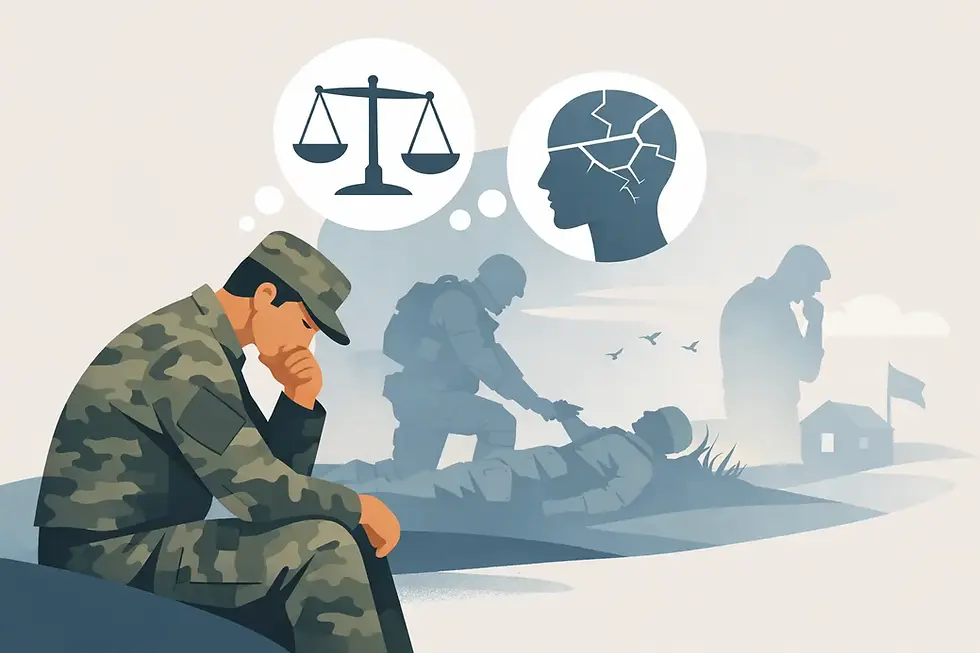
For many veterans, first responders, trauma survivors, and spiritually sensitive people, this idea lands with a kind of painful relief. It helps explain why certain fears feel ancient, why grief can seem bottomless, or why a person can work hard to change and still keep repeating the same emotional cycle. When the wound is bigger than the individual story, healing often has to include more than the individual self.
What ancestral healing for trauma really means
At its core, ancestral healing for trauma is the process of addressing burdens passed through a family system. Those burdens may show up as chronic fear, emotional numbness, rage, shame, loyalty to suffering, relationship instability, addiction patterns, or a persistent sense of not being fully free.
Some people understand this through family systems. Others understand it through epigenetics, where stress responses can be shaped by what previous generations survived. In shamanic work, there is also an energetic and spiritual lens. Unresolved pain can remain active in a lineage. Grief can stay frozen. Harm can leave an imprint. Sometimes descendants feel that imprint without knowing its source.
This matters because many people have been taught to approach healing as if every symptom begins and ends with their own choices. Personal responsibility matters, but that framework can become brutal when someone is doing everything they can and still feels trapped. Sometimes the nervous system is reacting to more than present-day stress. Sometimes the soul is carrying a family burden that was never named, honored, or released.
Signs you may be carrying inherited trauma
There is no single checklist that proves ancestral burden. Still, certain patterns come up often.
You may notice recurring themes in your family line, such as addiction, abandonment, violence, mental health struggles, or early death. You may feel intense guilt for wanting a different life than the people who came before you. You may carry grief that seems disproportionate to what is happening now. Some people also feel a strange pull toward suffering, as if peace is unfamiliar or unsafe.
Another sign is when healing work helps, but only to a point. You gain insight, maybe even real progress, yet a deeper layer remains untouched. That does not mean you failed. It may mean the work needs to go beyond coping skills and into inherited survival patterns, spiritual contracts, family entanglements, or unresolved ancestral pain.
This is especially common in people from lineages marked by combat, colonization, forced migration, family silence, religious trauma, or generations of emotional suppression. In those systems, survival often came at the cost of connection. The descendants then inherit the adaptation without understanding the original wound.
Why talk therapy alone may not reach it
Talk therapy can be life-changing. For many people, it is a vital part of recovery. But ancestral trauma is not always stored in a way that words can easily access.
Some of it lives in the body as vigilance, collapse, or emotional flooding. Some of it appears in dreams, family patterns, or repeated life situations that make no logical sense. Some of it carries a spiritual weight that does not resolve through analysis alone.
That is where a more holistic approach can help. Breathwork, somatic support, ritual, grief work, energy clearing, and trauma-informed shamanic healing can create movement where insight by itself has stalled. The goal is not to replace clinical care or pretend one modality fixes everything. The goal is to work at the level where the burden is actually held.
How ancestral healing for trauma is approached in spiritual work
Real ancestral healing is not fantasy, and it should never be used to bypass personal responsibility. A grounded practitioner helps you stay connected to your body, your present life, and your actual healing process. The work is meant to restore power, not create dependence or fear.
In a trauma-informed spiritual setting, the process often begins by listening for patterns. What keeps repeating in your family? What emotions feel older than you? Where do you feel bound by loyalty, guilt, fear, or grief?
From there, healing may involve clearing inherited energetic burdens, witnessing grief that never had a place to go, identifying family contracts around suffering or silence, and helping the client release what is not truly theirs to continue carrying. Sometimes the work also includes reconnecting with benevolent ancestral support. Not every ancestor is a source of pain. Some are ready to help once the distortion in the line is addressed.
This kind of work can be subtle or intense. Some people feel immediate relief. Others experience layer-by-layer change over time. It depends on the nature of the trauma, the resilience of the nervous system, and how much support the person has in place.
Healing the line without romanticizing the past
One of the biggest misconceptions is that ancestral healing means excusing harmful family behavior. It does not.
You can honor the suffering your ancestors survived without justifying what was passed down. You can have compassion for the wounds in your lineage and still be honest about abuse, neglect, addiction, or violence. In fact, honesty is often what breaks the cycle.
The aim is not to make the past look beautiful. The aim is to stop unconscious loyalty to pain. Many people were taught that belonging means carrying the same burden as their parents or grandparents. Healing asks a harder question: what if love also means ending the pattern?
What change can look like
Ancestral healing rarely looks dramatic from the outside at first. It may show up as better sleep, less reactivity, fewer intrusive emotional spirals, or a new ability to feel grief without drowning in it.
Over time, people often report a deeper shift in identity. They no longer feel fused with family pain. They can make choices without the same level of guilt or internal backlash. Relationships become clearer. The body softens. There is more room for peace.
For trauma survivors, that change matters. For veterans and first responders, it can be the difference between living in constant internal threat and beginning to trust that safety is possible again. For parents, it can mean not handing the same unresolved burden to their children.
Who this work is for - and when to move carefully
This approach can be deeply supportive for people who feel called to spiritual healing and who have enough stability to process what surfaces. It can pair well with therapy, recovery work, somatic healing, and strong community support.
It is not about chasing mystical explanations for every struggle. Sometimes a panic response is rooted in present-day burnout. Sometimes family pain is psychological more than spiritual. Sometimes it is both. A skilled practitioner does not force one explanation onto every person.
If you have severe dissociation, active psychosis, or are in acute crisis, the work needs to be approached very carefully and with proper support. Good trauma-informed healing respects pace. It does not push someone into overwhelm just because a wound is old or spiritually significant.
At PNW Shamanic Healing, this kind of work is approached with that respect. The point is not to impress someone with spiritual language. The point is to help them come home to themselves with more clarity, safety, and freedom than they had before.
There are burdens that belong to your story, and there are burdens you were handed. Learning the difference can change everything. If part of your pain feels ancient, unnamed, or woven through your family line, that does not mean you are broken. It may mean your healing is asking to go deeper, with care, honesty, and the courage to let the cycle end with you.


Comments